mobile domain:mobile.usaa.com
Skip to Content

Guard and Reserve members: Celebrate turning 60 with benefits

Discover retirement benefits for Guard and Reserve members at 60, including military pensions, TRICARE coverage, and retirement pay details.

Article: 6 minutes

Updated: March 12, 2026 Published: April 5, 2022

By: Josh Andrews, CFP® Reviewed by: Editorial contributors

Note:

Information courtesy of USAA Life Insurance Company and USAA Life Insurance Company of New York.

Here's something you probably don't hear too often: I'm looking forward to my 60th birthday. It may be 15 years from now, but unlike active-duty retirees who get their military retirement pay and health care immediately upon retirement, most of us National Guard and Reserve retirees have to wait until we're 60 to get those benefits.

If you're waiting for your military retirement, below are a few reasons turning 60 will be a financial celebration and a few financial actions you can take while you wait for that day to arrive.

Reason 1: Military pension kicks in for Guard and Reserve members.

The extra income a military pension provides comes as you're taking advantage of those last few years to save money before retirement. Due to periods of qualifying service, a retiree in some cases could qualify for reduced eligibility Opens in a New Window.‍ ‍ See note 1 This only applies to retirement pay, not health care.

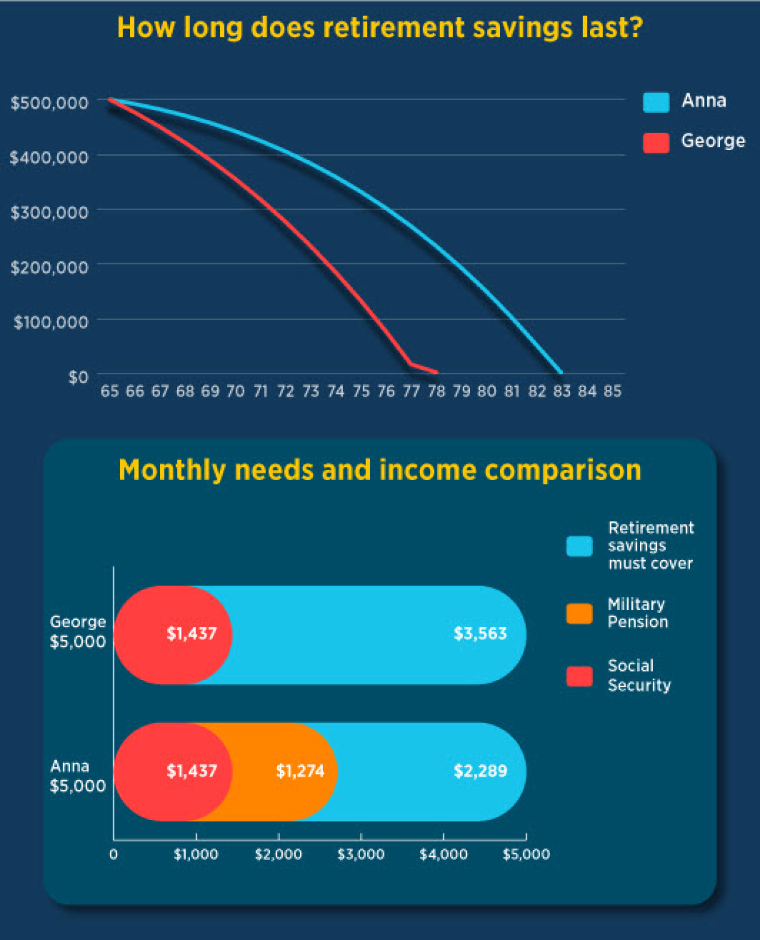
To understand just how beneficial military retirement can be, let's compare two 65-year-olds retiring from their civilian jobs this year. They each have $5,000 a month in expenses and a life expectancy of 85.

  • Anna retired from the National Guard. She gets $1,274 per month from her National Guard pension. Through her time in the military and in her civilian career, she saved $500,000 in her retirement portfolio.
  • George never served in the military. Through his civilian career, he saved $500,000 in his retirement portfolio.

We'll assume that both Anna and George's investments will receive the same 4% rate of return in retirement, and each will get $1,437 in Social Security benefits (SSB).

Using the simple formula of subtracting income from expenses, we can see how much Anna and George need each month from their retirement portfolio to meet their living expenses.

  • George: $5,000 in expenses minus $1,437 SSB equals $3,563 per month.
  • Anna: $5,000 in expenses minus $1,437 SSB and minus $1,274 in pension equals $2,289 per month.

When we plug this into a simple withdrawal calculator using a 3% inflation rate, George's savings are projected to run out at age 77, while Anna's savings are projected to last until age 82. This makes sense. Because George is withdrawing more each month from the same bucket of money, it won't last as long. That's the value of the military pension.

Graph indicating how long George and Anna's money is projected to last and a chart showing how much they need to pull from savings to cover monthly needs.

Video Duration:

Consider this: There's another important takeaway from this analysis. Even with Social Security and military benefits, Anna will likely outlive her savings.

As you plan for retirement, think about how you want to live. As a general rule of thumb, you can expect your retirement expenses to be 70% to 85% of what they were in the final years of your career. If your retirement salary is $100,000 a year, you might expect for $70,000 or $85,000 of yearly retirement expenses.

Now add your expected military retirement and SSB. If that number falls short of your expenses, you'll want additional retirement savings.

Don't forget: If you chose Option A for your Reserve Component Survivor Benefit Plan (RCSBP), age 60 is when you'll make your RCSBP decision. If you have a family member who relies on your income, consider passing a portion of your military retirement pay on to them by electing RCSBP coverage. This helps provide for them financially in case you die. Learn more about your RCSBP decision.

Reason 2: You become eligible for TRICARE.

Health care costs rise as we age. TRICARE offers health care for military members and their families, including retired active-duty Reserve and Guard members. There are a lot of great reasons to sign up: Expenses are low, premiums are low and deductibles are low. Now, lower is a relative term but it is lower than many health care plans I've researched.

Consider this: Unfortunately, not all providers accept TRICARE. Rural areas may have a smaller number of doctors, which means you could have to travel some distance for your health care.

The bottom line is, before you decide on TRICARE for yourself and your family, check with your preferred providers to be sure they accept it.

Reason 3: At 65, you get TRICARE For life.

At this point, Medicare becomes your primary health insurance, and TRICARE For Life serves as a free supplement that covers additional costs. TRICARE For Life is free for those who are enrolled in Medicare Parts A and B and are paying their Medicare Part B premiums. If this is all confusing language, I suggest you read our article that gives a good overall summary of Medicare.

A recent study from Fidelity showed that a 65-year-old couple could pay $315,000 out of pocket for health care costs over the remainder of their lives. When you consider that the TRICARE For Life catastrophic cap is $3,000 per year, a person who lives to age 95 will pay a maximum of $90,000, far less than the $315,000 from the recent study.

Consider this: You may need to switch doctors if you switch to TRICARE. Be sure to shop around to be sure your medical needs will continue to be met. For more information, read the article How to get health insurance when leaving the military.

Military retirement and long-term planning

Depending on your individual situation — whether you're an active-duty retiree or retired from the National Guard or Reserves — benefits like TRICARE and military retirement can help safeguard your golden years.

Even if you're like me and 60 feels a long way off, just knowing military retirement and TRICARE are on their way can grant some peace of mind as you budget for retirement.

No matter where you are in your career or how long it is until you begin to receive your well-earned military benefits, it's never too late to make adjustments to ensure you have the income you need in retirement.
Plan for the life you want in retirement.

Learn more about retirement income planning.

Learn more about retirement planning.

Related articles

Understanding your Thrift Savings Plan (TSP) options

Article: 3 minutes

Read article: Understanding your Thrift Savings Plan (TSP) options

Saving for retirement, even if you're behind

Article: 6 minutes

Read article: Saving for retirement, even if you're behind

Health insurance options for military veterans

Article: 6 minutes

Read article: Health insurance options for military veterans

Related footnotes:

  1. You are leaving USAA and being directed to a third party site that is not maintained, owned or operated by USAA. USAA does not control and is not responsible for the site content or the privacy or security practices of third parties. You should read the third party's privacy and security policies and site terms, as their practices may differ from those of USAA.

Related footnotes:

  1. The information contained is provided for informational purposes only and is not intended to substitute for obtaining professional financial advice. Please thoroughly research and seek professional advice before acting on any information you may have found in this article. This article in no way attempts to provide financial advice that relates to all personal circumstances.

  2. No Department of Defense or government agency endorsement.

  3. Learn about USAA's use of Artificial Intelligence.

    Life insurance and annuities provided by USAA Life Insurance Company, San Antonio, TX and in New York by USAA Life Insurance Company of New York, Highland Falls, NY. All insurance products are subject to state availability, issue limitations and contractual terms and conditions. Each company has sole financial responsibility for its own products.

  4. For services payable by both Medicare and TRICARE For Life, Medicare pays first and the remaining liability may be paid by TRICARE For Life.

  5. "TRICARE" is a registered trademark of the TRICARE Management Activity. All rights reserved.

  6. Certified Financial Planner Board of Standards Center for Financial Planning, Inc. owns and licenses the certification marks CFP®, CERTIFIED FINANCIAL PLANNER®, and CFP® (with plaque design) in the United States to Certified Financial Planner Board of Standards, Inc., which authorizes individuals who successfully complete the organization’s initial and ongoing certification requirements to use the certification marks.

6091509