mobile domain:mobile.usaa.com
Skip to Content

Tips for sorting out your estate plans

Don't leave your loved ones guessing. Develop an estate plan to carry out your wishes. Learn about wills, trusts, beneficiaries and more.

Article: 4 minutes

Updated: May 23, 2026 Published: May 13, 2015

By: USAA Reviewed by: Editorial contributors

Summary

Estate planning helps ensure your wishes are followed and reduces family conflict. Everyone could benefit from having basic legal documents, like a will and powers of attorney, and keeping them updated. Consider a trust for more complex financial or family situations. Working with an attorney can help ensure everything is done correctly.

Key Takeaways:

  • Estate planning is for everyone: Regardless of wealth, having a plan helps prevent disputes and ensures your wishes are carried out.
  • Core documents are critical: A will, powers of attorney, living will, and supporting instructions form the foundation of an effective estate plan.
  • Keep plans updated and consider trusts: Regularly review your documents and explore trusts for more complex family or financial situations to improve control and efficiency.

Over the years, we've all seen or heard about families fighting in court over estates of wealthy celebrities, such as singer Michael Jackson or baseball Hall of Famer Ted Williams. But the truth is, these battles can happen in anyone's family.

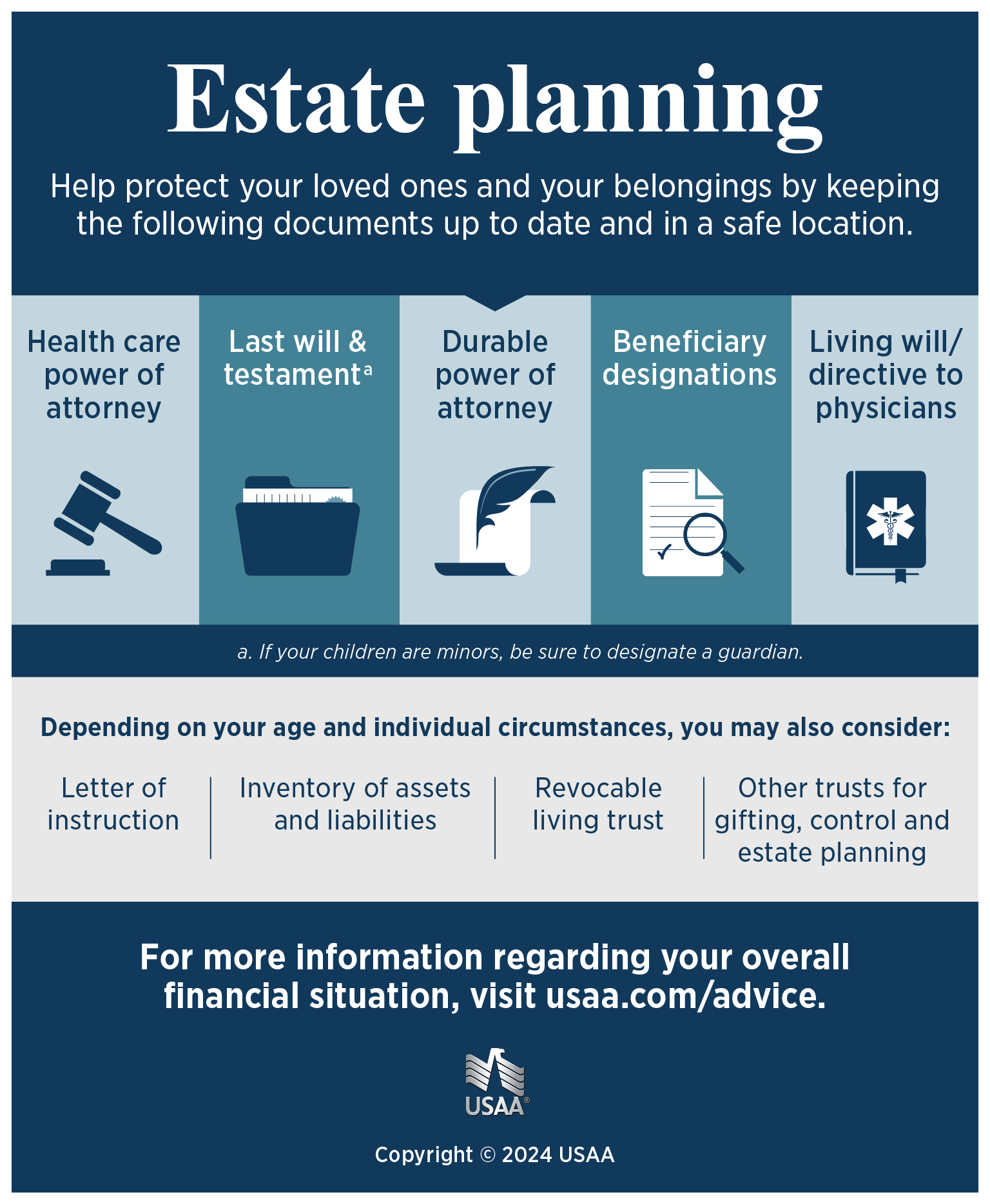
Estate Planning infographic. Help protect your loved ones and your belongings by keeping the following documents up to date and in a safte location: Health Care Power of Attorney,  Last Will and Testament (if your children are minors, be sure to designate a guardian), Durable Power of Attorney, Beneficiary Designations, and a Living Will (also know as a Directive to Physicians). Depending on your age and individual circumstances you may also consider having: Letter of Instruction, Inventory of Assets and Liabilities, Revocable Living Trust, and Other Trusts for Gifting Control and Estate Planning. For more information regarding your overall financial situation, visit usaa.com/advice.

Video Duration:

Highlights

  • Complete legal documents.
  • Consult an attorney.
  • Consider establishing a trust.
  • Discuss your wishes with loved ones so they are prepared and to help reduce conflict.

Sometimes people mistakenly believe that estate planning is only for the rich and famous. That belief couldn't be further from the truth.

One key to any well-established plan is the same for everyone: Have the right paperwork that's up to date. You may need the following five important documents as part of your plan.

Five documents you may need

  • A last will and testament, often simply referred to as a will, allows you to:
    • Distribute assets and property in accordance with your wishes.
    • Designate an executor of your estate, such as a trusted relative, friend or corporate executor, saving the cost of a court-appointed attorney.
    • Choose a guardian for your minor children.
  • A living will generally allows you to express your wishes with respect to certain types of medical treatment, such as life support if you're terminally ill.
  • A durable power of attorney for finances designates a person you trust to make financial decisions and pay your bills now and after you become incapacitated. A springing power of attorney could be used if you wish the power to only spring into effect in the event of incapacitation.
  • A medical power of attorney authorizes a person to make medical decisions on your behalf, including wishes expressed in your living will.
  • A letter of instruction is an informal, nonlegal document that helps surviving family members put your affairs in order, from making funeral arrangements to canceling credit card accounts and paying other bills. It even can include personal thoughts and instructions, such as how to care for a prized orchid collection or what's in a safe deposit box.

Once these basic documents are in place, you can have the peace of mind that comes with knowing your affairs are in order. As time passes and your life changes, you need to keep them up to date.

It's not one and done when it comes to estate planning. Your documents should be reviewed at least every three to five years to ensure they still reflect your wishes and current laws.

Consider establishing a trust.

Beyond the basic documents, establishing a trust may be the next major step in your overall estate plan. Here are a few situations where a trust may be appropriate:

  • Blended families. You may find that a simple will is inadequate and must note that intestacy laws, which determine default rules for how assets pass in the absence of a will or trust, typically do not recognize step-relationships. As such, having everything default to a spouse could risk unintentionally disinheriting children from a prior relationship.
  • Minor children. For example, a testamentary trust as part of your will can specify when a child is to receive an inheritance and how the money is to be spent. Trusts also can help provide for children with special needs by paying for expenses not covered by government programs.
  • Real estate in more than one state. A trust can help avoid the attorney and court fees associated with going through probate in each state where you own property.
  • Life insurance. Trusts can hold life insurance intended to pay estate taxes, equalize the value of inheritances for business owners or create liquidity for other purposes. The benefits and rules associated with a trust and life insurance will vary depending on whether the trust is the owner of the life insurance policy, the beneficiary, or both.

Where to go for help

Consult an attorney. While many estate planning documents may be available online, consider hiring an attorney experienced in estate planning to prepare customized documents or at least review online forms you're working to complete.

Active-duty service members and their dependents as well as  retired service members and their dependents may be eligible to take advantage of no-cost legal assistance. Commonly known as JAG, this service can include estate planning. To find a general legal services provider within the continental United States, visit the U.S. Armed Forces Legal Assistance LocatorOpens in a New Window.‍ ‍ See note 1

For more education or to find a local attorney who specializes in estate planning, visit the American College of Trust and Estate CounselOpens in a New Window.‍ ‍ See note 1

Choose how you engage with the process.

Trust & Will lets you be in control, have someone help you, or get support from an attorney.

Visit Trust & Willto learn more

Related articles

Effective estate planning strategies

Article: 8 minutes

Read article[: Effective estate planning strategies]

Loss of a loved one: Financial guidance

Article: 2 minutes

Read article: Loss of a loved one: Financial guidance

Terminally ill checklist: Get your affairs in order

Article: 4 minutes

Read article: Terminally ill checklist: Get your affairs in order

Related footnotes:

  1. You are leaving USAA and being directed to a third party site that is not maintained, owned or operated by USAA. USAA does not control and is not responsible for the site content or the privacy or security practices of third parties. You should read the third party's privacy and security policies and site terms, as their practices may differ from those of USAA.

Related footnotes:

  1. The preceding discussion is not tax, legal or estate planning advice. Consult with your tax, legal or estate planning professional regarding your specific situation.

  2. The information contained is provided for informational purposes only and is not intended to represent any endorsement, expressed or implied, by USAA or any affiliates.

  3. USAA means United Services Automobile Association and its affiliates. Life insurance and annuities provided by USAA Life Insurance Co., San Antonio, TX, and in NY by USAA Life Insurance Co. of New York, Highland Falls, NY. Other life and health insurance from select companies offered through USAA Life General Agency, Inc. (known in CA (license #07822131) and in NY as USAA Health and Life Insurance Agency).

    USAA Federal Savings Bank offers deposit, credit card, consumer lending, mortgage, and other banking products and services. USAA Federal Savings Bank is a Member of FDIC. Credit card, mortgage, and other lending products not FDIC-insured.

  4. USAA Life General Agency, Inc. is not affiliated with Trust and Will or Huge Legal Technology Company, Inc., nor do we guarantee the quality of their products or services. Although we receive compensation from and may promote and/or recommend the products offered by these companies, consumers should review the product carefully prior to making a purchasing decision.

  5. This content is provided for information purposes only. Estate planning and probate services are provided by Trust & Will, an online service providing legal forms and information. Trust and Will is not a law firm and they do not provide legal advice.

  6. The trademarks, logos and names of other companies, products and services are the property of their respective owners.

6623412